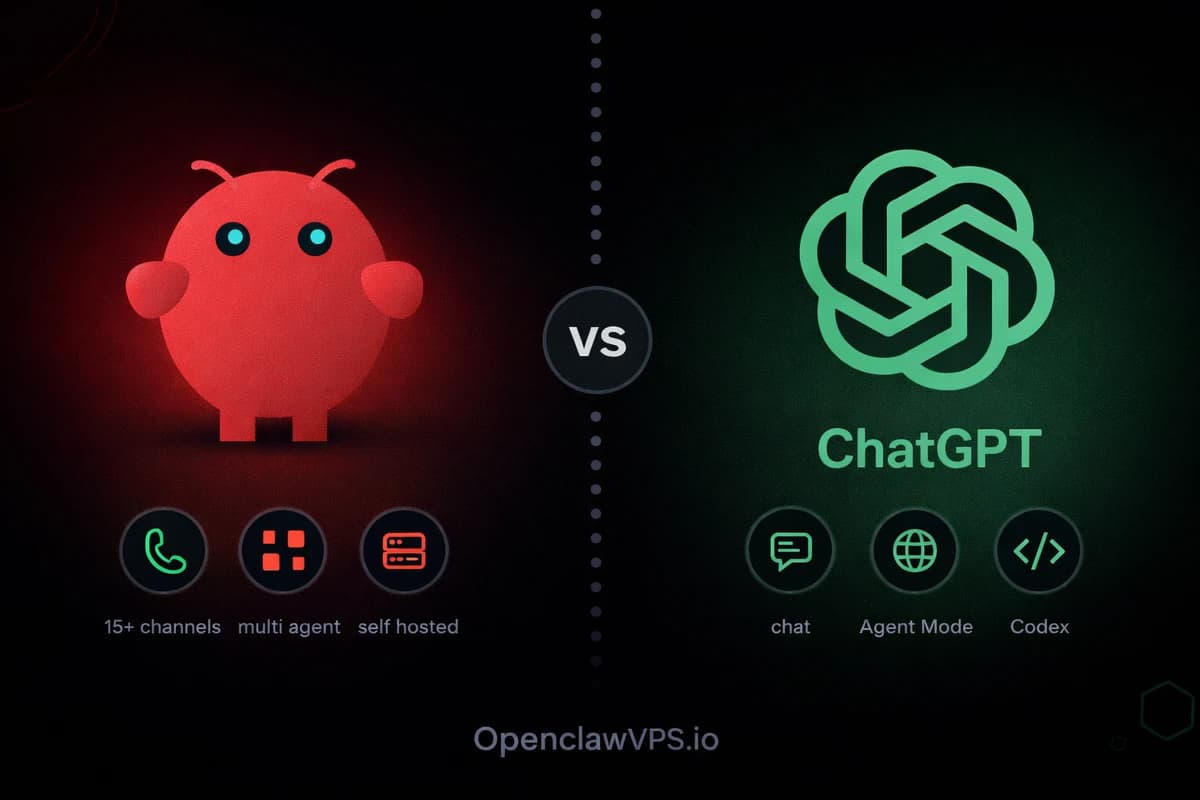
TL;DR: OpenClaw is a self-hosted agent platform. ChatGPT is OpenAI's consumer AI product. They're not competitors because OpenClaw can run GPT models as its backend. Use ChatGPT for chat, research, creative work, and browser-based agent tasks. Use OpenClaw with GPT for WhatsApp/Signal messaging, multi-model agents with cost routing, always-on 24/7 automation, and full data control on your server. ChatGPT's Agent Mode and Codex are powerful but locked to OpenAI's ecosystem and need the browser open.
ChatGPT has 900 million weekly users. I'm one of them. Quick research, brainstorming, image generation, Agent Mode for booking things I don't want to book manually. I also run three OpenClaw agents powered by GPT-5.4 through the API. One handles WhatsApp. One runs scheduled reports at 6am. One monitors a Discord server around the clock.
Same models. Different wrappers. Different jobs.
The "vs" framing is misleading here, more than usual. ChatGPT is a product — the most popular AI product ever built. OpenClaw is infrastructure (here's the full OpenClaw explainer if you need the basics). ChatGPT is what you open when you want to talk to GPT. OpenClaw is what you deploy when you want GPT to work without you watching. You can literally run GPT inside OpenClaw.
OpenAI ships features at a pace that's hard to track. GPT-5.4 dropped on March 5. Agent Mode evolved from Operator last July. Codex launched in February as a full coding platform. Custom GPTs, Deep Research, Sora video, Connectors, Projects. ChatGPT in March 2026 barely resembles ChatGPT from March 2025.
This is where things stand now. When ChatGPT covers what you need, and when running GPT through OpenClaw earns the extra setup.
What ChatGPT looks like in March 2026
GPT-5.4 dropped on March 5 and it's a big jump. State-of-the-art coding, native computer use, tool search across large tool ecosystems, and a 1M-token context window in the API. It replaced GPT-5.2 Thinking for Plus, Team, and Pro users.
Agent Mode is the feature that changed what ChatGPT can do. It evolved from Operator last July and runs on its own virtual computer inside OpenAI's infrastructure. It browses real websites, fills forms, creates spreadsheets and slideshows, books travel, schedules tasks. You describe what you want and it acts. Not a chatbot pretending to browse — an actual agent clicking through pages.
Codex launched in February as a full coding platform. Multi-agent workflows with parallel worktrees, 30-minute agent runtimes, a skills library. Currently macOS only, but it competes directly with dedicated coding tools.
The rest of the stack: Custom GPTs for building specialized assistants without code. Deep Research for multi-source web synthesis. DALL-E and Sora for image and video generation. Advanced Voice Mode. Projects for organizing work by client or campaign. Connectors linking Gmail, GitHub, Slack, and Google Drive. Over 50 million paying subscribers and 9 million business users.
ChatGPT feature stack (March 2026)
- No self-hosting option
- GPT models only
- No WhatsApp / Telegram / Signal
- Agent Mode needs browser open
- Usage caps on every tier except Pro ($200/mo)
Where ChatGPT stops: no self-hosting option, data lives on OpenAI's infrastructure, usage caps on every tier except Pro ($200/month), locked to GPT models only, no WhatsApp or Telegram or Signal integration, Agent Mode needs the browser open, and Codex is macOS only as of today.
What OpenClaw adds on top
OpenClaw is the deployment layer. GPT (or Claude, or Gemini, or a local Ollama model) is the intelligence it runs.
Messaging is the widest gap. ChatGPT works through web, mobile apps, and desktop. That's it. OpenClaw connects to 15+ channels: WhatsApp, Telegram, Discord, Slack, Signal, iMessage, Matrix, Email, IRC, Teams. If your customers reach you on WhatsApp or your team coordinates on Signal, ChatGPT can't meet them there.
Multi-agent with model mixing is the other big difference. I run a coding agent on GPT-5.4 for anything that needs frontier reasoning. A scheduling agent on GPT-5.2 for cheap background work. A research agent on DeepSeek for bulk processing. Each agent has its own workspace, its own model, its own budget. ChatGPT gives you one assistant per conversation. Agent Mode is powerful, but it's one agent doing one task at a time.
The skills library on ClawHub has 13,700+ entries. ChatGPT's Custom GPTs ecosystem is large — over 3 million GPTs in the store — but Custom GPTs are wrappers around the same model with custom instructions. OpenClaw skills extend what agents can do at the system level: tools, integrations, automations.
24/7 is where the architectures diverge completely. OpenClaw agents run on your server. Cron jobs trigger at 3am. Heartbeats check services every 5 minutes. A Telegram bot answers customers while you sleep. ChatGPT's Agent Mode runs in a virtual browser on OpenAI's servers, which is impressive, but you have to kick it off. It doesn't wake up on its own.
And then there's privacy. Your prompts, your data, your logs. Everything stays on your hardware. For GDPR compliance, company policy, or anyone who doesn't want their conversations stored on someone else's infrastructure.
- 💬MessagingWhatsApp, Telegram, Discord, Signal, Slack, iMessage, 15+↓
- ⚡OpenClaw GatewayAgent routing, SOUL.md, heartbeats, cron, memory↓
- 🧠ModelsGPT-5.4, Claude, Gemini, DeepSeek, Ollama (local)↓
- 🔧Skills + MCP13,700+ tools: calendar, email, GitHub, database, web search
The trade-off: you manage the server. Config files, gateway setup, updates. Time and knowledge that ChatGPT never asks for.
Don't want to manage a server? OpenClaw VPS handles the hosting, security hardening, and updates. Your OpenClaw instance, pre-configured and always online. Plans start at $12/month.
Side by side
| Feature | ChatGPT | OpenClaw + GPT |
|---|---|---|
| Chat interface | Web, iOS, Android, desktop | Telegram, WhatsApp, Discord, Signal, 15+ |
| Coding | Codex (multi-agent, macOS only) | Agent automation + any coding model |
| Agent tasks | Agent Mode (virtual browser, real-world actions) | Always-on server agents, cron, heartbeats |
| Skills/tools | Custom GPTs, Connectors, Deep Research | 3,200+ on ClawHub |
| Data privacy | OpenAI's servers | Your server, your data |
| Setup | 2 minutes | 30-60 minutes self-hosted |
| Monthly cost | $0-200/user flat | Server ($5-20) + API tokens |
| Models | GPT only | GPT, Claude, Gemini, DeepSeek, Ollama |
| Scheduled tasks | Agent Mode (manual trigger, recurring possible) | Cron, heartbeats, 24/7 autonomous agents |
| Messaging channels | Web/mobile/desktop only | WhatsApp, Signal, iMessage, 15+ |
| Usage limits | Yes (caps on every tier except Pro at $200) | No caps, pay per token |
| Multi-agent | Codex only (coding), single assistant in chat | Multiple agents, different models each |
| Image/video | DALL-E + Sora built in | Via skills or API integrations |
Agent Mode is ChatGPT's strongest card. It can book flights, fill spreadsheets, research competitors, and create slide decks — all from a single prompt. OpenClaw can't do that natively. If you need an AI that browses the web and takes actions for you, ChatGPT Agent Mode is ahead.
Model flexibility is where OpenClaw pulls away. Routing a scheduling agent to GPT-5.2 at $1.75 per million input tokens while your main agent runs GPT-5.4 at $2.50. Mixing in Claude for long-context work, MiniMax M2.7 for cheap agentic coding, or a local Ollama model for anything that shouldn't leave your network. That kind of routing doesn't exist inside ChatGPT.
When ChatGPT is enough
For most people reading this, ChatGPT Plus at $20/month covers what they need.
You want chat, research, and creative work? ChatGPT is better at those than any self-hosted setup. Agent Mode handles real-world tasks that used to require dedicated automation tools. It books travel, fills out expense reports, creates financial models. Deep Research synthesizes information from dozens of sources and produces polished reports.
Codex is a legitimate coding platform. Multi-agent workflows with worktrees, parallel task execution, 30-minute agent runtimes. If you're a developer on macOS, Codex competes with (and in some cases beats) dedicated coding tools.
Custom GPTs let you build specialized assistants without writing code. Upload your brand guidelines, connect your knowledge base, share it with your team. Three million GPTs in the store means someone has probably built what you need already.
You work solo. You don't need messaging bots. You don't need agents running at 3am. You hit the free tier limit but Plus gives you enough headroom.
Honest estimate: 80% of readers don't need OpenClaw. ChatGPT keeps absorbing capabilities that used to require separate infrastructure.
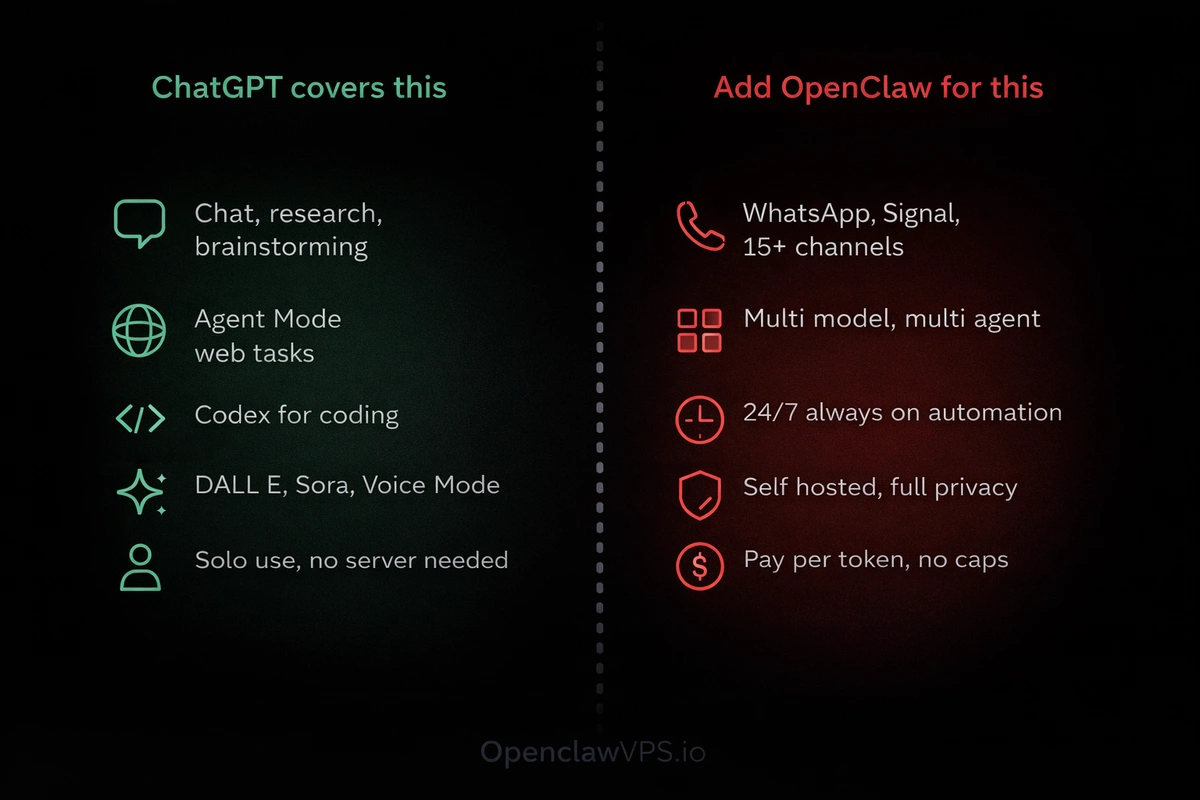
When OpenClaw with GPT makes more sense
The remaining 20% have specific needs that ChatGPT can't address.
You need WhatsApp. Or Signal. Or iMessage. Or Matrix, IRC, Teams, Email. ChatGPT works through its own apps and browser. OpenClaw connects to fifteen messaging platforms. If your business runs on WhatsApp or your community lives on Matrix, there's no ChatGPT workaround.
You run multiple agents with different jobs and different cost profiles. A GPT-5.4 agent for complex customer queries. A GPT-5.2 agent for heartbeats and monitoring. A Claude agent for long-document analysis. A local Ollama model for anything that can't leave your network. ChatGPT can't mix models. OpenClaw assigns a different model to every agent.
Your data can't leave your server. GDPR. Company policy. Personal preference. OpenClaw keeps prompts, logs, and memory on your hardware. ChatGPT Business and Enterprise offer data controls, but the infrastructure is still OpenAI's.
You need agents that work without anyone watching. Cron jobs. Heartbeats. A WhatsApp bot that handles customer questions at midnight. A monitoring agent that alerts you when something breaks. Agent Mode is powerful but it's a tool you activate — not a service that runs in the background.
You're burning through Plus limits. 160 messages every 3 hours sounds generous until you're iterating on a complex project. Pro at $200/month removes the caps, but that's $2,400/year. OpenClaw with API tokens has no caps and lets you route cheap tasks to cheap models. One community member cut their monthly cost from $943 to $347 by routing background tasks to cheaper models. That kind of optimization isn't possible on a flat subscription.
If none of these apply, ChatGPT Plus is the right call.
Skip the server setup entirely. OpenClaw VPS comes pre-configured with GPT, Claude, Gemini. Deploy in under 5 minutes.
Running GPT inside OpenClaw
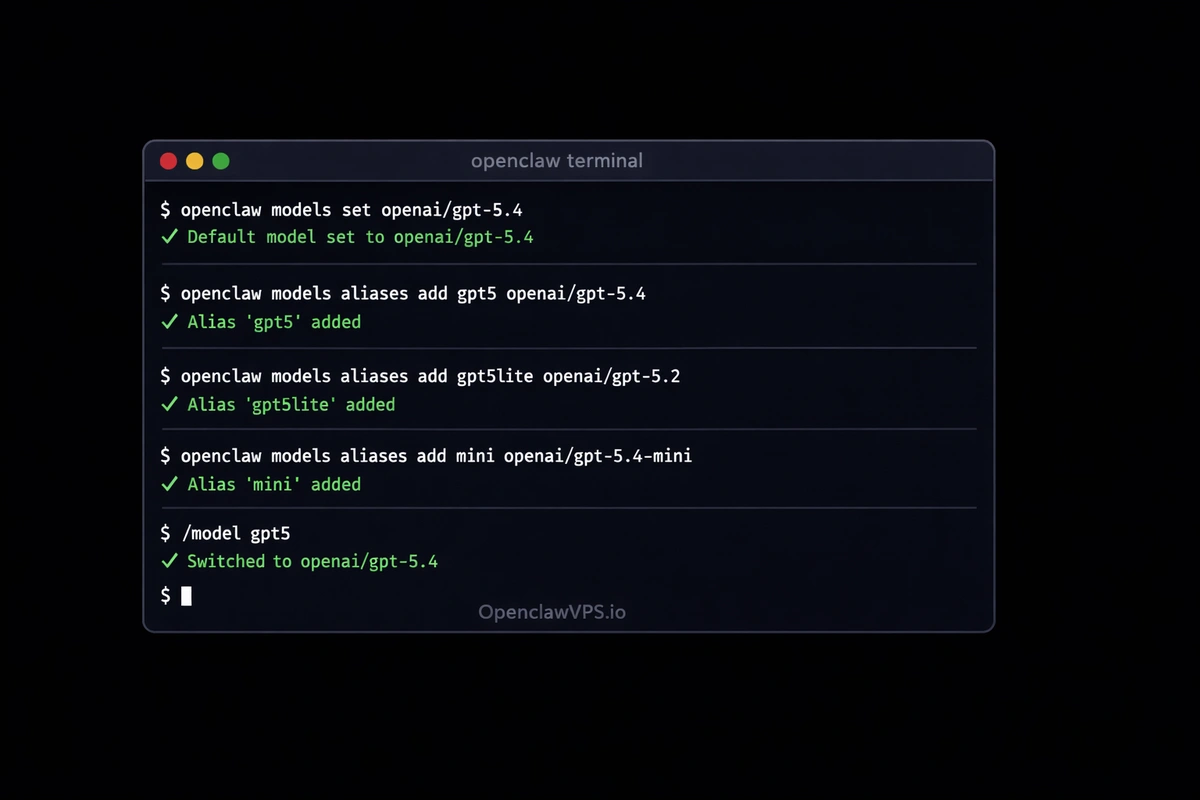
Setting up GPT as the backend takes about two minutes. Add your OpenAI API key to openclaw.json, then:
openclaw models set openai/gpt-5.4Set up aliases so you can switch between GPT variants:
openclaw models aliases add gpt5 openai/gpt-5.4
openclaw models aliases add gpt5lite openai/gpt-5.2
openclaw models aliases add mini openai/gpt-5.4-mini
Now /model gpt5 or /model mini works from any chat. Watch for the allowlist gotcha: once you add models to agents.defaults.models, it becomes an allowlist and rejects anything not on the list. The full ChatGPT configuration walkthrough covers the OAuth-vs-API-key fork in more detail, including the wizard trap that catches everyone and the six gotchas Codex OAuth ships with.
The cost math
Monthly cost comparison
ChatGPT Free
ChatGPT Go
ChatGPT Plus
ChatGPT Pro
OpenClaw + API
ChatGPT Free: $0. Limited to 10 messages every 5 hours. Unusable for real work.
ChatGPT Go: $8/month. Unlimited basic GPT-5.2. No Thinking model, no Sora.
ChatGPT Plus: $20/month. The sweet spot for solo users. Includes everything most people need.
ChatGPT Pro: $200/month. Unlimited everything. Worth it if you regularly hit Plus caps.
OpenClaw + GPT API: Server cost ($5-20/month for a VPS, or free on existing hardware like an old Mac Mini or Android phone) plus API tokens. GPT-5.4 runs $2.50 input / $15 output per million tokens. GPT-5.2 is $1.75/$14. GPT-5.4-mini is even cheaper for lightweight tasks.
For light use — a few conversations a day, occasional Agent Mode tasks — ChatGPT Plus wins. $20 flat, no thinking required.
For heavy multi-agent use with thousands of daily messages, OpenClaw with API tokens can cost less. Route heartbeats and monitoring to GPT-5.2 at $1.75 per million tokens. Run complex tasks on GPT-5.4. Mix in local models for anything that doesn't need a frontier model. That kind of cost engineering doesn't exist inside ChatGPT.
The hidden cost is always your time. Managing a server, updating configs, debugging when gateway routing breaks at 2am. If your hourly rate is high and you only use basic chat features, ChatGPT Plus at $20 buys you freedom from all of that.
Use both
ChatGPT for...
- Quick research and brainstorming
- Agent Mode (booking, forms, spreadsheets)
- Image and video generation
- Deep Research reports
- Casual one-off questions
OpenClaw for...
- WhatsApp / Telegram / Signal bots
- Agents that run 24/7 unattended
- Multi-model cost routing
- Data that can't leave your server
- Scheduled reports and monitoring
I keep saying "I use both" because I do. ChatGPT lives in my browser for research, brainstorming, and Agent Mode tasks. OpenClaw runs on my server with three agents handling WhatsApp, monitoring, and scheduled reports. All day, every day.
Not competing. Complementing.
If you're starting fresh, try ChatGPT Plus. It's $20 and productive in two minutes. When you hit a wall, you'll know exactly which wall it is. The walls people hit: needing WhatsApp bots, needing agents that run overnight, needing data sovereignty, needing to mix models to control costs. That's when OpenClaw earns its setup time.
And when that happens, OpenClaw doesn't replace ChatGPT. It gives GPT a bigger stage to work on. Check the alternatives comparison if you want to see how other platforms stack up, or the OpenClaw vs Claude comparison for a different angle.